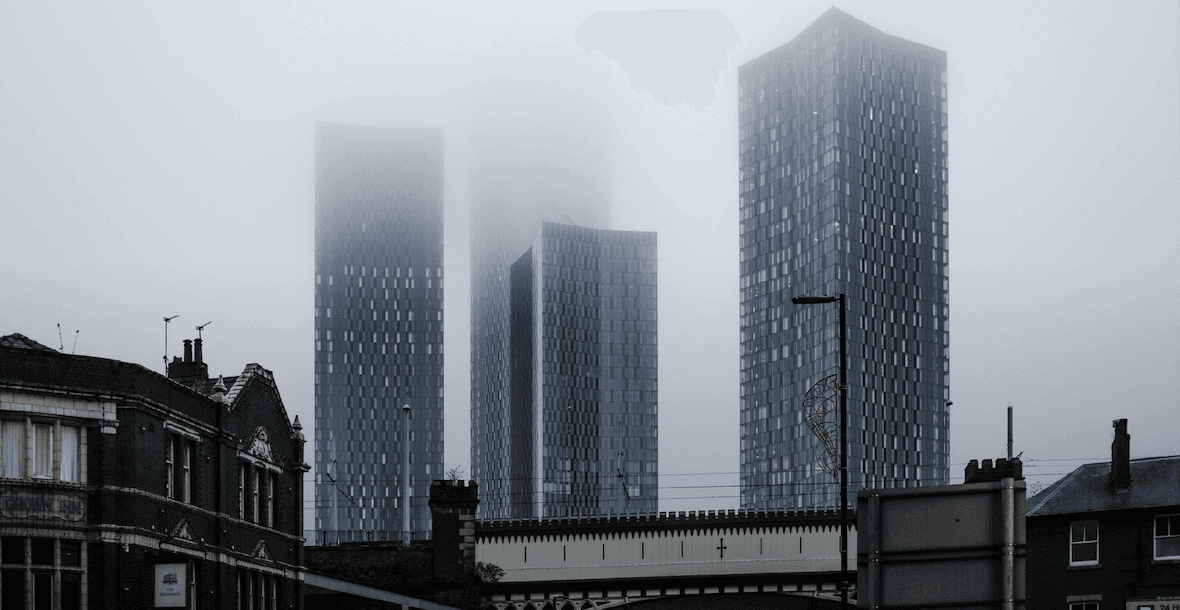
Greater Manchester's economy is popping off, productivity is rising faster than London, investment is flowing and cranes scatter the skyline. But in all this progress, there are tough questions to ask, like who gets to live in these new neighbourhoods, and at what cost?
The BRIK-Down
The Greater Manchester Housing Strategy set out a long-term vision to deliver homes that people want and need, at least 36,000 affordable homes by 2032, with at least 10,000 as social homes.
At the same time, the Manchester Strategy has been smashing its goal to become one of the world's top cities, with a strong economy and highly skilled people. These two strategies are at odds with each other, playing out in regeneration schemes that both come to the rescue and cause complexities.
But, Manchester City Council did recently pass a motion to increase social and affordable housing targets in the city.
The new number to meet is 21% of new housing developments (of 10 homes or more) for social rent. That's a significant leap from the previous target of only 5% of new housing developments of 15 homes or more.
While this sounds like good news, it might not when the evidence shows 32% of new build homes need to be for social rent to address the housing crisis across GM.
So, let's take a deeper look.
The Regeneration Game
Regeneration has re-cast the Core Zone (AKA Salford Quays to Ancoats) as neighbourhoods to know, the world over. But the balance between high-end development and affordable housing is hotly debated - and even parodied, if you saw Hooch's localised campaign taking aim at the evolution of Ancoats...
Too often, new homes come with the luxury treatment and price tag to match, while affordable or social housing gets sidelined.
Coming back to tough questions, we have a biggie: Isn't regeneration without affordability just gentrification by a different name?
The Numbers
With almost half a million on waitlists for social housing and an estimated 18,000 affordable homes needed a year to meet local need, we know there's demand. But how about supply?
In the Core Zone: In central Manchester and Salford, demand is highest, but only 1% of all new units built between 2012 and 2020 were genuinely affordable. High-spec schemes set the tone and affordability is a footnote.
In the South-East Corridor: Stockport and Rochdale's regeneration projects hold hope.
Stockport has schemes like the 100%-affordable development, Higher Hillgate, but the town's renaissance is set to spark inward migration, which could make it a victim of its own success on the housing front.
In the Gateway Towns: As reboots of established towns, Wigan and Bury offer opportunities to tilt the balance earlier, building in affordability before luxury takes hold. As part of 'Places for Everyone' Bury is working to deliver at least 25% of its homes as affordable options.
Lessons from London
Of course, our London neighbours are no stranger to a housing crisis.
Since the early 2000s, their strategic framework for development in the city has tackled the issue using inclusionary zoning and affordable quotas (35%+ on major schemes).
Delivery lags reality, but it has increased the supply of affordable housing for those who need it.
Manchester's approach has been more flexible, focused on securing capital first, placemaking second (and affordable provision if possible).
The upside: momentum. The risk: affordability gaps widen faster than they can be closed.
Our Take
Manchester has proved it can compete with London on growth, but we're trailing behind on social equity. And shouldn't the two go hand in hand? For the city to realise its economic trajectory, while also building homes the next decade of growth demands. The opportunity is there, through devolved powers, strategic planning and proactive quotas. We created the productivity boom, let's cater for it.