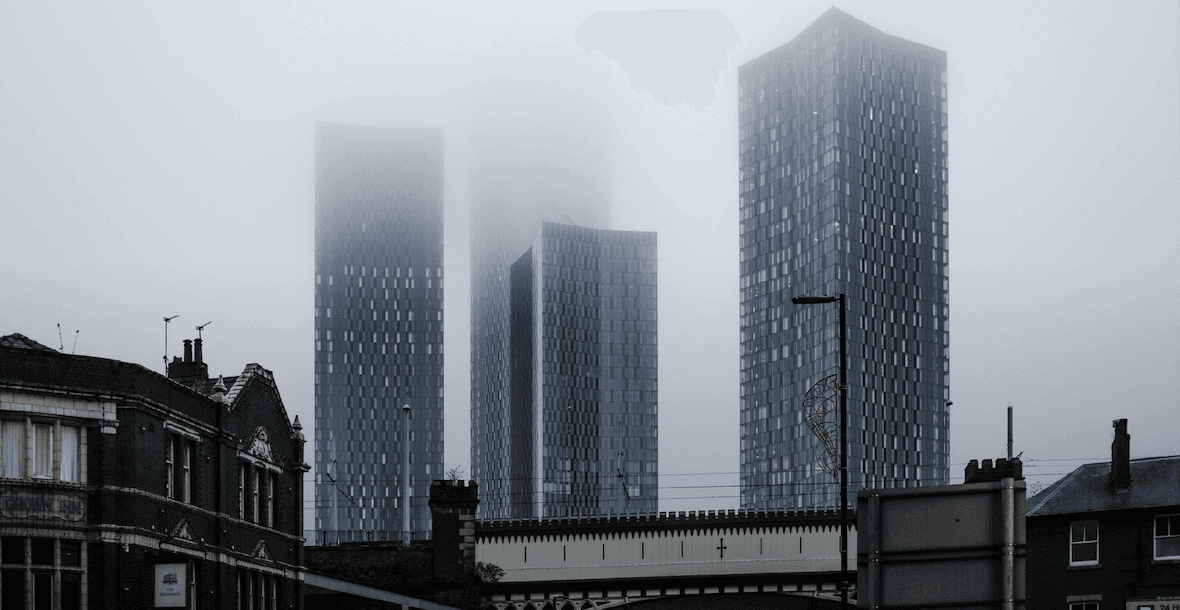
Manchester used to get labelled as a 'regional city', but the last decade has seen the city outgrow this title to become a strong, self-sustaining standalone. A place that produces talent, holds onto it, attracts more and feeds what it's got through industry opportunity and investment.
This change in trajectory is evident in graduate retention, startup formation and global companies' long-term capital commitments to the Grade A office market. Taken together, these indicators point to a significant truth: Manchester is no longer a second city competing for attention; it's one with a workforce that's second to none.
The BRIK-Down
Manchester sits at the centre of one of the UK's largest student and graduate ecosystems. Around 70,000 students are based in the city, with 100,000 enrolled across the wider region. And every year, tens of thousands graduate into the job market. Scale aside, isn't that the way it works everywhere?
Actually, no, and Manchester's pipeline differs in how much of that talent pipeline sticks around locally.
Independent analysis suggests more than half now stay in the city after completing their studies, a serious hike from the early 2010s. But that's not all, because even those who study in other locales are flocking home to Manchester when they graduate.
This pull matters because talent retention is one of the most reliable predictors of long-term urban growth. Cities that keep graduates are where companies feel confident to recruit, expand and invest. If they can attract them back, even better.
From 'Branch Office' to Real Roots
That confidence shows up as major employers choosing to locate teams here. Not as a short-term play in a cheap postcode, but as a long-term opportunity fed by an established labour market up to supporting operations.
The last ten years has seen Manchester attract or win expansions from international businesses like:
--> THG
The local heavyweight has scaled its technology, digital and logistics workforce from right here.
--> Amazon
Establishing a major Manchester office with hundreds of roles across corporate and technical functions.
--> Google
Growing its regional presence beyond sales into engineering and cloud-related roles.
--> Goldman Sachs
Maintaining a Manchester presence that supports global financial operations.
--> Deloitte
Its Manchester outpost was originally based in a WeWork, but the worldwide firm moved to a 65,600 sqft dedicated HQ in 2024, making the city one of its key locations.
--> Bank of New York Mellon
Taking one of the city's most prominent Grade A lettings in full.
Just Listen to the Leasings
Let's linger on that last example for a moment.
Bank of New York Mellon, the oldest bank in the US took all 200,000 sq ft of Manchester's newest Grade A space at 4 Angel Square. 11 stories, not exactly a move that says, 'commitment issues'
This move reflects Manchester's more-than-healthy Grade A office market. And that matters, because businesses don't commit to long-term leases in premium buildings without trust in talent, that it can grow to meet new roles, and the pool staying competitive with other cities.
The city's leasing trends show our strong workforce goes hand in hand with a strong demand for high-quality workspace, a key capital signal.
--> Annual office take-up consistently exceeds long-term averages
--> Grade A space accounts for more than half of total leasing activity
—> Prime and Grade A vacancy has remained exceptionally tight, typically around 2-4% in the city centre
--> New, flagship buildings are getting good pre-let numbers
And all this in the era of hybrid working? Manchester hasn't only moved businesses past the 'branch office' mindset, it's made them see and commit to the city as a strategic hub, playing a bigger role within national and international corporate networks.
Pathways look far more local these days.
It Starts On Campus
One of the most slept-on signs of a shifting workforce shows up way before the employment stats. At campus career fairs. University job conventions used to see London-based firms dominate, peddling the theory that graduates had to come to the big smoke to make their mark.
Lucky for Manchester, they've shifted agenda.
Pathways look far more local these days, with the next wave of grads getting to meet global firms with established Manchester teams, professional services companies offering full career tracks in the city, or scaleups and high-growth businesses head-hunting locally. When graduate expectations are shaped early, the influence of these events can't be underestimated.
They send the message that a world of opportunity awaits talent in Manchester, and keep straying eyes convinced to stay put.
Diversity Is Our Strong Suit
The big thing Manchester has down to a fine art is sector diversity. Alongside growing corporate investment, the startup scene has become its own player in the city's economic structure. The number of active high-growth firms has risen all across digital technology, ecommerce and advanced services, and a growing pool of founders build multiple businesses that move beyond early-stage into scale. This attracts talent wanting alternatives to the corporate ladder, making Manchester the place to be for would-be founders, technologists and risk-takers who might have looked to London or overseas to match their ambition.
Diversity lets people shapeshift between roles, industries and career stages without leaving the city, one of the defining characteristics of globally competitive urban economies.
At the same time, Manchester isn't associated with one dominant industry. Once a textile titan, now the landscape is split, with media, creativity, professional and financial services, technology and ecommerce and life sciences all contributing to a rich and interconnected labour market. This diversity lets people shapeshift between roles, industries and career stages without leaving the city, one of the defining characteristics of globally competitive urban economies.
Together, these dynamics form a powerful cycle. The result is an ecosystem where talent comes, sees and stays, exactly the conditions for a city to scale with confidence.
Our Take
Talent may be Manchester's most valuable asset.
The city has progressed by producing it, retaining it and creating the conditions for it to grow, made possible through strong universities, corporate investment, startup activity and sector diversity.
Together, that's formed many of the foundations of a self-sustaining talent economy.
Maintaining the trajectory now depends on how we support what we've built. The people and businesses who've already chosen Manchester need to keep choosing it for their futures. That means housing that works beyond a graduate's first job, transport and public realm that make density feel like an advantage, workspace that supports both multinationals and scaling firms, and deeper links between universities, SMEs and founders. If all that continues to strengthen, Manchester holds onto its winning formula, and cities on top of their talent cycle tend to keep growing.